Master of Education Program at Casa Hererra

UT Master of Art Education students spent the Holly Week celebration engaging in lectures, field trips and the ancient tradition of "alfombra" making at Casa Herrera.

Learn more about the program

Casa Herrera Study Abroad Program

Join Students from around the world to learn about Mesoamerica and Maya Writing at Casa Herrera, The University of Texas at Austin’s center for learning and scholarship in the heart of Antigua, Guatemala.

Learn more about the Spring 2014 Study Abroad Program

What is Casa Herrera?

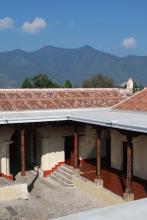
Casa Herrera is a 17th century colonial property located in the heart of Antigua, Guatemala. As an extension of The Mesoamerica Center, the Casa’s programs facilitate the study and appreciation of Pre-Columbian art and archaeology and the indigenous cultures of Mesoamerica.

Learn more about Casa Herrera and its programs

View from location

What is Casa Herrera?

Casa Herrera is a 17th century colonial property located in the heart of Antigua, Guatemala. As an extension of The Mesoamerica Center, the Casa’s programs facilitate the study and appreciation of Pre-Columbian art and archaeology and the indigenous cultures of Mesoamerica.

Learn more about Casa Herrera and its programs

Casa Herrera


Welcome

The Casa Herrera is a new research, conference and teaching facility located in the heart of Antigua, Guatemala, operated by the Department of Art and Art History at the University of Texas at Austin in collaboration with the Fundación Pantaleón. As an extension of the university’s Mesoamerica Center, the Casa Herrera focuses on the varied and inter-related disciplines that contribute to the study of Pre-Columbian art, archaeology, history and culture. Its larger mission is to create new opportunities for education and research, facilitating learning and dialogue in many fields of study, among scholars and students from many institutions and nations in Central America and beyond.

Highlighted News and Events

The ancient Maya meet the modern Internet

David Stuart

Researchers began decoding the glyphic language of the ancient Maya long ago, but the Internet is helping them finish the job and write the history of this enigmatic Mesoamerican civilization. COFA's David Stuart started a blog for scholars and amateurs.

Read the article on The Washington Post about Dr. David Stuart's blog

John Kerry Hosts Event at UT Austin Mesoamerica Center in Guatemala

ANTIGUA, Guatemala — Secretary of State John Kerry hosted an event that included University of Texas at Austin faculty members and students earlier today at Casa Herrera, an extension of UT Austin’s Mesoamerica Center.

Group photo of Secretary Kerry and Chair of Department of Art and Art History an
Image by English Access Microschool Scholarship Program

Kerry was accompanied by members of the U.S. Embassy and representatives from UT Austin including Jack Risley, chairman of the Department of Art and Art History; David Stuart, director of the Mesoamerica Center and a professor of art history; and students studying abroad at Casa Herrera from the university’s College of Education. His visit was attended by international media.


Dr. Luis Gordo Pelaez joins the Spring Semester Abroad Program

Dr. Luis Gordo Pelaez

Dr. Gordo Pelaez is currently  a lecturer on Colonial Spanish America in the Department of Art and Art History. He will join the Study Abroad program at Casa Herrera in Antigua, Guatemala in spring 2014 where he will teach a course on Baroque art and architecture in Colonial Mexico and Guatemala.

Spring 2014

Spend Spring Semester Abroad in  Guatemala & Belize!

Join Students from around the world to learn about Latin America, Mesoamerica, and Maya Writing at Casa Herrera, The University of Texas at Austin’s center for learning and scholarship in the heart of Antigua, Guatemala. 

Studying abroad is the most effective way to learn a language. By immersing yourself in a different culture, you will continually hear and practice speaking the language you are trying to learn in its natural context.

Casa Herrera brings interrelated disciplines together to study Pre-Columbian art, archaeology, history and culture in a historically significant and picturesque setting. The facility, which dates to 1680, is one of the great, original houses of colonial Antigua. As part of this semester study abroad program, students take courses from a UT faculty, and experience culture through intensive language at a local language school. All classes are taught in English. In addition, students  have the opportunity to learn Spanish or Kaqchikel Maya language.

Enroll in the program and get credits for the following classes:


Copan Field Trip
Copan Ruin, Honduras Field Trip

The Archeology of MesoamericaANT 324L / ARH 374 / LAS 327 

Mesoamerica is one of the great cultural regions of the world. Its ancient history saw the rise and fall of several remarkable civilizations, all sharing many fundamental ways of life and ways of looking at the world, with cities, states, empires, and written histories. Today the living descendents of the ancient Maya, the Zapotec, and the Aztec (among others) continue to adapt their own identities to the modern world, only a few centuries after the harsh series of conquests they experienced.

This class we will focus on ancient Mesoamerican cultures through an in-depth examination of their art and extensive archaeological remains. We begin the course by looking at what “Mesoamerica” means as a cultural label, as well as examining the ideas that led to the creation and sustainability of Precolumbian art, religion and political economy. One essential goal is to become familiar with the ideas, institutions and ethos of a very “alien” human culture that existed so near us geographically, and which still resonates strongly in the cultural expressions and identities of modern people in Mexico, Central America and even in the United States. Art is the best avenue we have in reaching this goal, which says something about the extraordinary role and communicative power of visual expression in the pre-modern world.

Maya Ruins field trip
Maya Ruins field trip, photo G. Flores

Colonial Spanish America: Baroque Art and Architecture in Colonial Mexico and Guatemala
Crosslisting TBD

This course aims to explore the visual culture of Colonial Spanish America within the context of the Baroque, one of the most prolific and captivating cultural movements in the New World. Through lectures, readings, and discussions, we will examine the aesthetics of the Baroque, its visual manifestations in Colonial Mexico and Guatemala, and notions such as power, identity, and hybridity. Students will be introduced to a variety of subjects including, but not limited to, the planning and building of colonial cities, such as Antigua or Santiago de los Caballeros and Nueva Guatemala; the public festivals in the Baroque New World; the cathedrals and the power of the Church; the monastic life and the building of urban monasteries and convents; the Baroque altarpieces and the retablo-façades; the artists, the guilds, and the workshop practices; the colonial shrines and miraculous images, such as the Black Christ of Esquipulas, Guatemala; the Virgin of Guadalupe and the marian devotions in Colonial Spanish America; the Jesuits and the arts; the building and decoration of private homes; and the portrait of the colonial society. 


Arch Santa Catalina
Photo C. Smith, Fall 2011

Colonial Encounter: Western and Indigenous Perspectives
ARH 374/ LAS 327

This course explores writings about the Aztec and Maya cultures of Mesoamerica spanning the period between the arrival of Hernán Cortés in Mexico in 1519 and the rediscovery of these indigenous civilizations by 19th century travelers exploring the abandoned ruins in the tropical jungles. Alongside western accounts of the Spanish Contact we will focus on the Aztec and Maya versions of the same events as they were recorded in indigenous histories, poetry, song, and letters to the King of Spain.

Course will examine parallel narratives of the arrival of the Spaniards, both in their own records of events, as well as in the indigenous writings of the people Of Mesoamerica. Analysis of the course materials will entail close readings, discussion of the relationship between style and content, and formal and informal writing assignments throughout the semester. This approach will generate a broader understanding of the myths that are often hidden behind conventional wisdom on the Conquest of the Americas, as well as give students the academic tools necessary to produce college-level prose.
 

Belize
Belize

Sacred Landscape in the Pre-Columbian World
ARH 370/ LAS 327/ GRG 356T

This course is an exploration of the concept of landscape and environment from the perspective of archaeology. Students will gather information on the cultural aspects of environments from short ethnographic fieldwork assignments, and reading of case studies. Readings will be drawn from environmental psychology, the anthropology of space, and landscape archaeology to examine a variety of topics including natural and constructed landscapes, private and public space, the built environment, memory and commemoration of events through space, practice and symbolism of food production, environments in cosmology, and archaeological reconstructions of ancient landscapes.

Case studies from Mesoamerica will highlight the social and cultural aspects of the study of ancient landscapes and provide students with a long-term horizon of the ways in which humans affect their environments, and how, in turn, environments shape cultural responses.